






 2027: IPC Tasks INEC VEP Officials on Electoral Trust, Information Integrity
By Wilfred Chukwuma
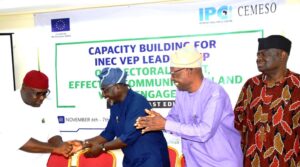
The International Press Centre (IPC) has charged officials of the Independent National Electoral Commission (INEC), particularly those in its Voter Education and Publicity (VEP) departments, to strengthen electoral communication, promote information integrity and build public confidence ahead of the 2027 general elections.
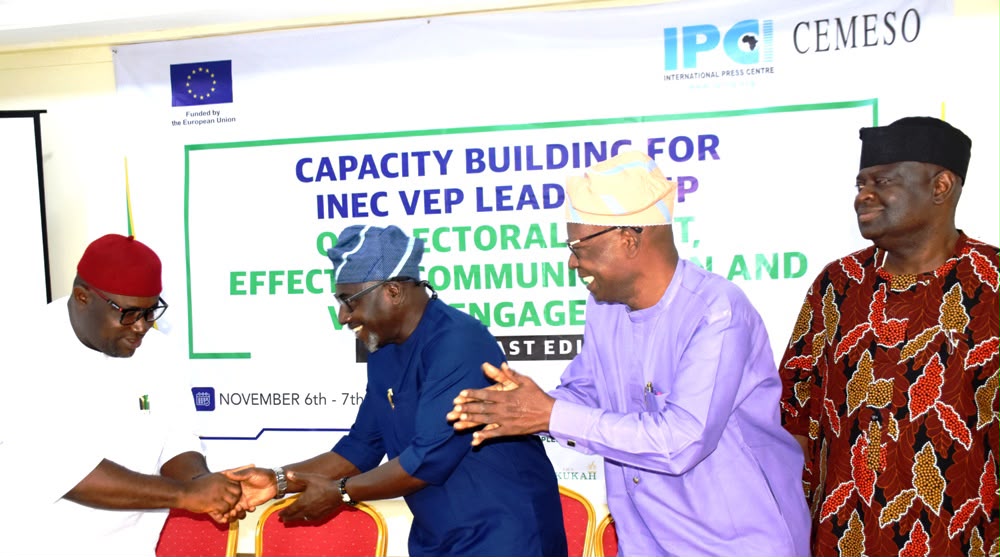
The Executive Director of IPC, Mr Lanre Arogundade, gave the charge while delivering his address at a two-day zonal capacity-building programme for INEC’s VEP leadership on Electoral Trust, Effective Communication, Legal Literacy and Voter Engagement, held in Enugu on Friday.
Arogundade, who spoke on behalf of IPC and the Centre for Media and Society (CEMESO), implementing partners of Component 4: Support to Media of the European Union Support to Democratic Governance in Nigeria (EU-SDGN) programme, stressed that electoral trust must be cultivated long before election day through accurate, accessible and credible information.
He observed that with the 2027 general elections drawing closer, INEC must strengthen its communication mechanisms to effectively address public controversies, uncertainties, misinformation and competing narratives without compromising accuracy, impartiality and public confidence.
According to him, VEP officials occupy a strategic position in the electoral trust-building process, as citizens’ perception of the credibility of elections is largely influenced by the information they receive, the timing of such information and the credibility of its sources.
“Trust is not built only on election day, but in the weeks and months before it; by what citizens know, when they hear it and who they hear it from,” he said.
The IPC boss expressed concern over the growing threat posed by artificial intelligence (AI)-generated content and foreign information manipulation, warning that emerging technologies had made it increasingly easy to fabricate statements, manipulate election result sheets and disseminate false narratives.
He disclosed that practical demonstrations and simulations during the programme had shown how human voices could be cloned within minutes and election result sheets falsified within seconds, creating an environment in which fabricated information could circulate faster than official corrections.
Arogundade also underscored the importance of legal literacy among voter education officials, particularly in communicating the provisions of the 2026 Electoral Act, noting that vague, misleading or inaccurate responses to voters’ legal inquiries could erode public confidence in the Commission.
He described the challenge as a major institutional responsibility requiring proactive, coordinated and credible communication strategies.
On the need for region-specific voter education, he maintained that Nigeria’s electoral information environment was not uniform, explaining that information needs, media access, public concerns and patterns of trust differed across regions and communities.
The two-day engagement, he said, was designed to equip participants with practical knowledge and skills in crisis and rapid-response communication, the 2026 Electoral Act as a communication instrument, media relations, misinformation risk mapping, conflict-sensitive communication and inclusive voter engagement.
He added that particular attention would be devoted to communication strategies targeting women, youths, persons with disabilities, first-time voters and other underserved groups.
Arogundade explained that the Enugu training was structured to address the peculiar realities of the South-East while building on lessons from similar programmes previously conducted in Ibadan and Jos.
He recalled that VEP officials in the four states involved in previous engagements played significant roles in media and stakeholder relations, information management and capacity-building during off-cycle governorship elections, contributing to the successes recorded in those electoral exercises.
The IPC Executive Director also highlighted the organisation’s iVerify fact-checking platform, which examines flagged claims, verifies them against available evidence and publishes findings supported by verifiable facts.
He said IPC had equally developed an iVerify guide to assist stakeholders in identifying and debunking deepfakes, adding that experiences from Ondo, Anambra, Ekiti and Osun states, where fact-checking units had been established with the organisation’s support, would form part of the training sessions.
He, however, cautioned that fact-checking alone could not adequately address electoral misinformation, stressing the need for proactive, coordinated and trusted communication to prevent false narratives from gaining ground.
Arogundade expressed appreciation to the European Union for funding the initiative, describing it as part of broader efforts to strengthen democratic governance through institutional support for INEC, the National Assembly, the Judiciary, political parties and civil society organisations.
He also acknowledged the contributions of INEC’s leadership, particularly National Commissioner, Muhammed Haruna, and Director of Voter Education and Publicity, Mrs. Victoria Etta-Messi, whose commitment, he said, had contributed significantly to the actualisation of the programme.
He urged participants to actively engage in the sessions, interrogate information, share experiences from their respective zones and leave the programme with practical commitments capable of strengthening electoral communication.
“Trust under pressure is built by those who are prepared, and you are the people who will carry it into 2027,” he charged.
In his remarks, the Executive Director of CEMESO, Dr. Akin Akingbulu, said the success of the programme would not be measured by the number of lectures delivered or certificates issued but by visible improvements in the communication capacity and professional competence of INEC officials ahead of the 2027 elections.
He emphasised that the training must translate into effective information dissemination at all levels of the Commission, including its grassroots offices.
“The job is done only when the officer at the smallest local government offices can give the same correct data as the one curated,” he stated.
Akingbulu further observed that the quality of information available to voters would significantly influence their electoral choices, urging participants to appreciate the enormous responsibility entrusted to them.
“Nobody will thank you for the rumours that never spread, or the voter who was never convinced, but in 71 days when Nigerians make their decision, the quality of that decision will carry fingerprints of all the people who are here,” he added.
Also speaking, the INEC Resident Electoral Commissioner (REC) for Enugu State, Dr. Chukwuemeka Joseph Chukwu, stressed the importance of effective communication and voter education during the pre-election and election periods, describing them as indispensable elements of successful electoral administration.
He urged INEC officials to ensure that electoral information was conveyed in simple, precise, understandable and acceptable language to enable voters to comprehend the electoral process and make informed decisions.
According to him, “electoral information should be communicated in a simple, precise, understandable and acceptable language.”
The REC further cautioned officials against allowing misinformation and false narratives, particularly those circulated through social media, to undermine the credibility of the electoral process.
“In today’s information age, false narratives and misinformation are spread gradually, particularly through social media. Therefore, officers must develop the capacity to respond calmly, professionally and responsibly, while ensuring that all information is properly verified before dissemination,” he said.
The programme featured presentations and lectures by Dr. Mohammed Amali and Dr. Monday Ashibogwu.
Also in attendance was the Director of INEC’s Voter Education and Publicity Department, Mrs. Victoria Etta-Messi, who was represented by the Deputy Director, VEP, Delta State, Mr. NseAbasi Iboro Udom, alongside heads of departments, directors, public relations officers and other senior officials of the Commission.
The capacity-building programme is aimed at strengthening INEC’s institutional communication framework, improving the professional competence of its voter education officials and enhancing public engagement as Nigeria prepares for the 2027 general elections.
EDITOR
Sam Udekwe is a journalist working in the News and Current Affairs department, Enugu State Broadcasting Service (ESBS) Enugu. He is well trained in all genres of journalistic venture.
Mr Sam read Mass Communication, graduating all with Distinction in National Diploma, Higher National Diploma and Postgraduate Diploma at IMT, Enugu and Madonna University, Okija, Anambra state, as well as M.Sc Mass Communication at National Open University of Nigeria.
He is the immediate past NUJ Chairman, Enugu state.
samowailo@gmail.com