 Enugu’s Mbah Unveils Record 1.62trn Naira 2026 Spending Plan, Prioritises Infrastructure, Education
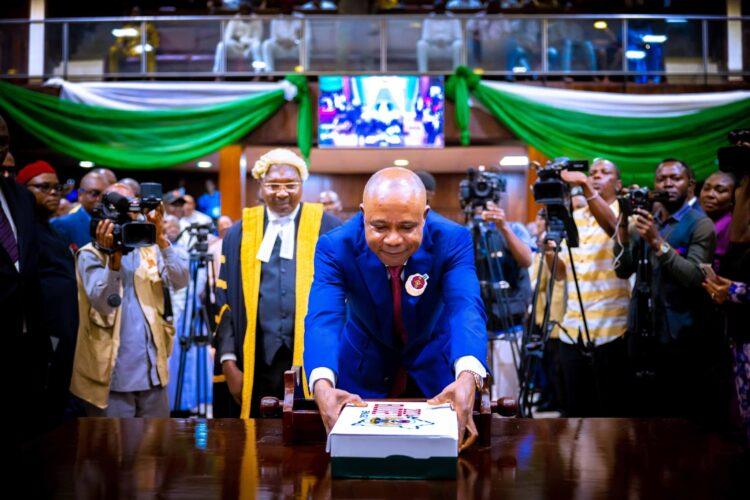
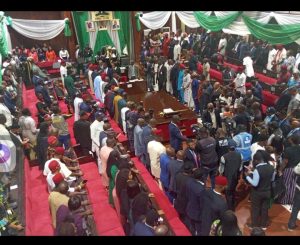
Governor Peter Mbah of Enugu State, on Tuesday, laid before the State House of Assembly a record-breaking 1.62 trillion naira budget proposal for the 2026 fiscal year, signalling what he described as a transition from foundation laying to full-scale transformation across critical sectors.
Tagged the “Budget of Renewed Momentum,” the proposal marks a 66.5 per cent leap from the revised 2025 budget of ₦971 billion. It comprises ₦1.296 trillion (80%) for capital projects and ₦321.3 billion (20%) for recurrent expenditure.
Revenue Framework
According to the governor, the budget will be funded through:
₦870 billion projected Internally Generated Revenue (IGR),
₦387 billion expected from FAAC,
₦329 billion in capital receipts.
Sectoral Allocations
The Economic and Social sectors dominate the 2026 allocations. The Economic Sector leads with ₦825.9 billion (51%), while the Social Sector follows with ₦644.7 billion (40.1%). Administration, Justice and Regional sectors are allotted ₦128 billion, ₦15.8 billion, and ₦2 billion, respectively.
Mbah said the robust economic sector allocation was intentional, stressing that investment in agriculture, industry and trade was central to his administration’s target of growing Enugu’s GDP seven-fold.
Infrastructure and Transport
Key capital projects include:
Construction of 1,200 new urban roads and extensive rural road networks.
Completion of the 40km Owo-Ubahu-Amankanu-Neke-Ikem dual carriageway.
Dualisation of Abakpa Nike–Ugwogo Nike–Ekwegbe–Opi-Nsukka Road.
Completion of the 21.65km Enugu–Abakaliki Expressway.
On transportation, the governor announced plans to expand the state-owned airline, Enugu Air, to 20 aircraft with the acquisition of 14 additional planes, three of which will arrive before end of 2025. Five new bus terminals will also be developed across Emene, Udi, Awgu, Ozalla (Four Corners), and Obollo-Afor.
The government is also dedicating 15 per cent of the entire budget to delivering 15,000 new mass housing units, alongside rapid expansion works at the New Enugu City.
Agriculture and Social Services
Mbah disclosed that the state would intensify the establishment of 20-hectare farm estates across all 260 wards, with several already underway.
In the Social Sector, education once again tops the chart, taking 32.27 per cent of the entire budget — continuing a pattern where over 30 per cent was devoted to education in the 2024 and 2025 budgets. The government will shift emphasis in 2026 to constructing Smart Secondary Schools and expanding Technical and Vocational Education and Training (TVET) centres, following progress on 260 Smart Green Primary Schools.
Other Allocations
₦20 billion is earmarked for clearing inherited gratuity arrears.
₦11 billion is set aside for the second phase of the state’s security surveillance project.
The health sector receives 10 per cent of the budget.
2025 Budget Performance
Reviewing the 2025 fiscal performance, the governor said the state had so far spent ₦806 billion, representing 97.5 per cent utilisation of actual revenues and 83 per cent implementation of the revised budget.
He noted extraordinary growth in state revenues, revealing that Enugu’s IGR would surpass ₦400 billion — the highest in the state’s history and a 221.6 per cent rise over 2024 figures.
FAAC and Federal Policies
Mbah commended President Bola Tinubu’s economic reforms, disclosing that Enugu received ₦230 billion in FAAC allocations against a projection of ₦150 billion, a surplus of more than 50 per cent.
He attributed this to macroeconomic improvements following fuel subsidy removal, FX unification and other fiscal measures, stating that inflation had trended downward, interest rates eased, and the exchange rate stabilised, while Nigeria’s foreign reserves recently climbed to $46 billion.
If you’d like, I can also produce a shorter version, a broadcast script, or an editorial-style analysis.
EDITOR
Sam Udekwe is a journalist working in the News and Current Affairs department, Enugu State Broadcasting Service (ESBS) Enugu. He is well trained in all genres of journalistic venture.
Mr Sam read Mass Communication, graduating all with Distinction in National Diploma, Higher National Diploma and Postgraduate Diploma at IMT, Enugu and Madonna University, Okija, Anambra state, as well as M.Sc Mass Communication at National Open University of Nigeria.
He is the immediate past NUJ Chairman, Enugu state.
samowailo@gmail.com