

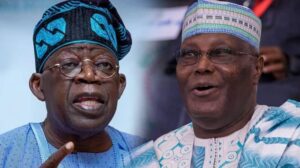
 2027: Between APC and the Opposition’s Compounded Woes
By Samson Ezea
Ahead of the 2027 general elections, it is becoming increasingly clear that the opposition’s woes and challenges are mounting rather than abating. Despite the stoicism displayed by opposition figures and their relentless social media activism, their political challenges continue to multiply as the 2027 general elections draw closer.
Two recent political developments underscore the reality that the opposition needs much more than social media mudslinging, outcries, propaganda, braggadocio and political grandstanding to defeat the ruling All Progressives Congress (APC) in the 2027 general elections.
Apart from the fact that the National Democratic Party (NDC) has no governorship candidates in 14 states and lacks candidates for more than 90 National Assembly seats, a situation that underscores the enormous task ahead of the party in its quest to win the 2027 elections, the recent Federal High Court judgment in Abuja, delivered by Justice Peter Lifu, sacking the David Mark-led leadership of the African Democratic Congress (ADC) and nullifying its decisions and actions, represents another major setback and distraction for the party.
This is so, regardless of how dismissive, critical or condemnatory the party and its supporters may be of the judgment. This is a judicial pronouncement whose final determination rests with the Supreme Court.
While Nigerians await further developments, particularly the outcome of the appeal against the recent ADC leadership judgment and the eventual decision of the Supreme Court, it is pertinent to recall that there have been instances in the nation’s political history when judgments of the apex court altered the political status quo at the eleventh hour without heaven falling or hell being let loose.
In Bayelsa State, for instance, the APC’s governorship candidate, David Lyon, was already making preparations for his swearing-in ceremony when, barely a day before his inauguration, a Supreme Court judgment upturned his electoral victory and paved the way for the emergence of the present Governor of Bayelsa State, Senator Douye Diri.
Similarly, during the 2019 general elections, the APC did not field any candidate in Rivers State following a Supreme Court judgment arising from the party’s protracted leadership crisis in the state. In Zamfara State, the APC won virtually all the elections in 2019, only for the Supreme Court to nullify its victories on account of a protracted leadership crisis within the party’s state chapter, which affected the validity of its candidate-selection process.
Consequently, candidates of the then opposition Peoples Democratic Party (PDP) were declared winners and subsequently sworn into office.
Therefore, as things stand, the opposition ADC must brace itself for whatever outcome the Supreme Court’s final determination of its leadership crisis may produce. The lingering crisis has undoubtedly thrown a spanner in the works of the party’s political mobilisation and electioneering activities ahead of the 2027 general elections.
Another development that could further compound the opposition’s woes ahead of the 2027 general elections is the recent endorsement of President Bola Ahmed Tinubu for a second term by General Theophilus Yakubu Danjuma (rtd.), a prominent and influential Nigerian statesman of Christian background from the North-Central region, whose political influence and stature extend beyond his immediate constituency and religious affiliation.
Danjuma made his position known at the 20th anniversary and fundraising ceremony of the Adamawa State Government House Chapel in Yola on Saturday, November 7, 2026. He was represented at the occasion by a former Chief of Army Staff, retired General Ishaya Bamaiyi.
In making a case for President Tinubu’s re-election, Danjuma argued that the President deserves another four-year term to consolidate and complete the programmes and projects initiated by his administration, as well as ensure the completion of the South’s turn in the Presidency.
He also commended the President for what he described as fairness, tolerance and inclusiveness in political appointments, particularly his appointment of Christians to strategic positions, notwithstanding the controversy that trailed the APC’s Muslim-Muslim presidential ticket in the 2023 general elections.
Consequently, he appealed to Nigerians, particularly people of the Middle Belt, to rally behind President Tinubu’s second-term ambition.
In addition to his political endorsement, Danjuma pledged ₦250 million towards the expansion of the Adamawa State Government House Chapel.
The endorsement is particularly noteworthy, considering Danjuma’s stature as a former military chief, former Minister of Defence and influential elder statesman with considerable recognition and influence across sections of the Middle Belt and North-East.
More importantly, it comes against the backdrop of President Tinubu’s efforts to consolidate political support across different religious, ethnic and regional constituencies ahead of the 2027 general elections.
Undoubtedly, Danjuma’s endorsement represents a significant political boost for President Tinubu and the APC. This is particularly so because he did not make a similar public endorsement in 2023, when the Labour Party’s presidential candidate, Mr Peter Obi, made significant electoral inroads in the North-Central region.
Nevertheless, the extent to which Danjuma’s endorsement will translate into actual electoral support remains a matter for the electorate to determine. Political endorsements, no matter how influential their proponents may be, do not automatically translate into votes.
However, they can shape political narratives, influence perceptions and strengthen a candidate’s acceptability across strategic constituencies.
These developments, alongside several other unforeseen political circumstances, emerging alliances and behind-the-scenes calculations, could finally shape the direction and outcome of the 2027 general elections.
As the political permutations and realignments continue to unfold, one thing is becoming increasingly evident: the road to 2027 may hold surprises for both the ruling APC and the opposition. The eventual outcome could be a source of shock and disappointment to some, just as it could bring unexpected triumph and delight to others.
Ezea writes from Independence Layout, Enugu State
EDITOR
Sam Udekwe is a journalist working in the News and Current Affairs department, Enugu State Broadcasting Service (ESBS) Enugu. He is well trained in all genres of journalistic venture.
Mr Sam read Mass Communication, graduating all with Distinction in National Diploma, Higher National Diploma and Postgraduate Diploma at IMT, Enugu and Madonna University, Okija, Anambra state, as well as M.Sc Mass Communication at National Open University of Nigeria.
He is the immediate past NUJ Chairman, Enugu state.
samowailo@gmail.com