










 Mbah’s “Your Honeymoon Is Over”: Charge, Challenge and Change
By Sam Udekwe
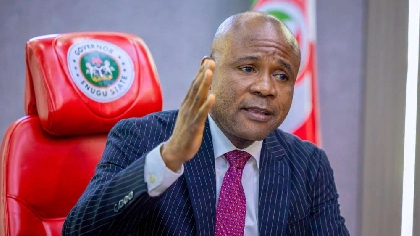
By any measure, it was a moment heavy with symbolism and expectation. Beneath the formal rituals of oath-taking and the solemn cadence of public service, Governor Peter Mbah’s message to the 13 newly sworn-in permanent secretaries was crisp, direct and unmistakable: your honeymoon is over.
Delivered without flourish, the admonition set the tone for a new phase in the administration’s governance journey – one defined not by ceremony, but by results. In a political environment often marked by extended acclimatisation to office, Mbah’s words served as a clear signal that performance, not privilege, would be the currency of relevance in his government.
The swearing-in ceremony, attended by senior government officials, technocrats and family members of the appointees, was expectedly dignified. Yet, beyond the smiles and photographs, the governor used the occasion to reinforce the seriousness of the task ahead. The permanent secretary, he reminded his audience, is not merely the administrative head of a ministry but the engine room where policy intent must translate into measurable outcomes.
In doing so, Mbah subtly but firmly redefined the meaning of bureaucratic power. The office was framed not as a reward for years of service or political loyalty, but as a platform for delivery. This reframing is significant in a system where senior civil service roles have often been associated with stability rather than innovation, continuity rather than urgency.
“The honeymoon,” in Mbah’s framing, was not an indulgence but a brief window for orientation. That window, he suggested, had now closed. What lay ahead was the demanding terrain of execution – tight timelines, clear benchmarks and unwavering accountability.
This posture departs from a familiar governance pattern in which new appointees are afforded extended periods to “settle down,” sometimes at the expense of momentum. By explicitly declaring the end of this phase, the governor introduced a sense of immediacy into the bureaucracy. The implication was clear: delays would not be explained away by institutional inertia or inherited constraints.
In many administrations, the bureaucracy is perceived as a brake on innovation, slowed by procedure, tradition and risk aversion. Mbah, however, projected a different vision. He challenged the new permanent secretaries to reimagine the civil service as a catalyst for growth: efficient, responsive and fully aligned with the broader development agenda of the state.
This is an ambitious expectation. It requires a shift from rule-bound administration to outcome-driven management, from file movement to problem-solving. For permanent secretaries, this means balancing compliance with creativity – ensuring due process without allowing it to become a refuge for inaction.
According to the governor, the success of any policy is ultimately determined not at the cabinet table but within ministries, departments and agencies where permanent secretaries hold sway. Their leadership, he noted, would be judged by how effectively they deploy resources, motivate staff and eliminate bottlenecks that frustrate service delivery.
This observation cuts to the heart of governance realities. Grand policy announcements often falter at the point of implementation, where capacity gaps, weak coordination and entrenched habits dilute intent. By placing responsibility squarely on the permanent secretaries, Mbah elevated their role from administrative custodians to strategic drivers of change.
A recurring theme in the governor’s address was the primacy of performance over longevity. Appointment to office, he implied, is neither an entitlement nor a lifetime guarantee. Relevance would be continuously earned through results.
This emphasis carries both promise and pressure. On one hand, it signals a merit-based ethos that could energise the civil service and attract a more results-oriented culture. On the other, it demands clarity in performance metrics and fairness in evaluation, lest accountability be perceived as arbitrariness.
Mbah’s charge to the new permanent secretaries reflects a broader governance philosophy anchored on speed, discipline and delivery. It suggests an administration impatient with excuses and focused on visible impact. If sustained, this approach could recalibrate the relationship between political leadership and the bureaucracy, narrowing the gap between vision and execution.
Yet, the success of this posture will depend on consistency. Performance-driven rhetoric must be matched with institutional support – training, data systems, clear mandates and protection for civil servants willing to innovate. Without these, the burden placed on permanent secretaries may prove unsustainable.
In declaring the honeymoon over, Governor Peter Mbah did more than issue a warning; he issued a challenge. The newly sworn-in permanent secretaries now stand at the intersection of expectation and execution, where the credibility of government is tested daily.
Their response whether marked by urgency or hesitation, will shape not only their individual tenures but also the trajectory of the administration’s reform agenda. In that sense, the ceremony was not an end, but a beginning: the quiet start of a demanding chapter where results, not rhetoric, will write the final verdict.
Udekwe,an online news editor, writes from Abakpa Nike

EDITOR
Sam Udekwe is a journalist working in the News and Current Affairs department, Enugu State Broadcasting Service (ESBS) Enugu. He is well trained in all genres of journalistic venture.
Mr Sam read Mass Communication, graduating all with Distinction in National Diploma, Higher National Diploma and Postgraduate Diploma at IMT, Enugu and Madonna University, Okija, Anambra state, as well as M.Sc Mass Communication at National Open University of Nigeria.
He is the immediate past NUJ Chairman, Enugu state.
samowailo@gmail.com