

 Worrisome Situation in Enugu State Over NDC’S Conduct of Primaries in Churches
By Dr Chidi Nwadeh
The growing intersection between politics and religion in Nigeria is fast becoming a source of serious concern. While religious institutions are traditionally regarded as sacred grounds for worship, moral guidance, unity, and spiritual healing, recent developments in Enugu State suggest an alarming shift that could dangerously politicize the Church and divide congregations along party lines.
Trending widely across social media platforms on May 29, 2026 — the day the National Democratic Congress (NDC) conducted its State and National Assembly primaries across the country was the controversial list of venues reportedly used for the exercise in several local government areas of Enugu State.
What shocked many observers was the overwhelming use of churches as designated venues for the party primaries.
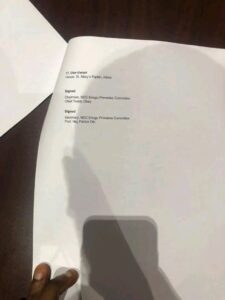
According to the published list issued by the NDC Enugu Primaries Committee, chaired by Chief Teddy Obey with Prof. Nky Patrick Obi serving as Secretary, several churches across the state were allegedly used for the political exercise.
For instance:
In Aninri Local Government Area, the venue was reportedly Assemblies of God Church, Ndeaboh.
In Awgu Local Government Area, the venue was St. Matthew Anglican Church, Awgu.
In Udi Local Government Area, the venue was St. Mary Catholic Church, Udi Station, Enugu State.
Similar reports emerged from other local government areas, indicating a widespread use of church premises for partisan political activities.
Assuming, without conceding, that the leadership and members of these churches were either aware of or approved the development, the silence from many religious authorities has remained deeply troubling. Even if the reports are false or exaggerated, the lack of prompt clarification or denial has only intensified public suspicion and concern.
At a critical moment like this, silence cannot be considered golden. There is a popular saying that “the real tragedy is not that evil exists, but that good people remain silent while wrong things happen.”
The apparent quietness of some church leaders on this sensitive issue may be interpreted as complicity, hypocrisy, or tacit endorsement.
No one disputes the constitutional right of every Nigerian including clergy and church members — to participate actively in politics. However, such participation must be exercised responsibly and in ways that do not compromise the neutrality, unity, and sanctity of the Church. A church should remain a spiritual home for all worshippers regardless of their political affiliations, not a partisan ground that appears to favour one political party over another.
If any clergyman desires full political participation, there is nothing wrong with openly identifying with a political party or contesting elections. Nigeria has witnessed clergymen who successfully ventured into politics. Rev. Moses Adasu and Rev. Jolly Nyame both served as elected governors of Benue and Taraba States respectively, while the current Governor of Benue State, Rev. Fr. Hyacinth Alia, remains a notable example of direct clerical participation in governance.
However, institutional involvement of churches in partisan activities presents a completely different and far more dangerous situation.
It is still fresh in public memory that the political tensions and divisions created within many churches during the 2023 elections have not fully healed. Congregations were polarized, friendships were broken, and spiritual unity was threatened because of perceived political alignments by some religious leaders and institutions.
Repeating such actions ahead of the 2027 general elections by allegedly allowing churches to serve as venues for NDC primaries amounts to inviting avoidable conflict, division, resentment, and distrust among worshippers.
No political party is more “Christian” or more “holy” than another, and no church member should feel marginalized, excluded, or disadvantaged because of differing political beliefs.
Unlike in 2023, many church members across denominations may openly resist any attempt to drag the Church deeper into partisan politics. The Church must never become an extension of political party structures or campaign machinery.
The earlier the affected churches and their leaders publicly clarify, condemn, and discontinue such developments, the better for the unity of the Church, the peace of the communities, and the preservation of the sacredness of religious institutions.
The Church must remain a sanctuary for all, not a battlefield for political supremacy.
.
Dr Nwadeh is the President, Enugu Christians in Diaspora, London Chapter.
EDITOR
Sam Udekwe is a journalist working in the News and Current Affairs department, Enugu State Broadcasting Service (ESBS) Enugu. He is well trained in all genres of journalistic venture.
Mr Sam read Mass Communication, graduating all with Distinction in National Diploma, Higher National Diploma and Postgraduate Diploma at IMT, Enugu and Madonna University, Okija, Anambra state, as well as M.Sc Mass Communication at National Open University of Nigeria.
He is the immediate past NUJ Chairman, Enugu state.
samowailo@gmail.com