

 Enugu at Full Throttle: Inside Mbah’s Trillion-Naira Leap Toward a Modern State
By Sam Udekwe
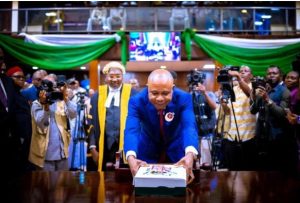
When Governor Peter Ndubuisi Mbah walked into the Enugu State House of Assembly on December 2, 2025, the chamber carried the quiet intensity of a state standing at the threshold of something vast. It was not just another budget presentation; it was a declaration of intent. A statement that Enugu, long considered a gentle provincial capital, was now bracing for a transformative jolt.
The 2026–2028 Draft Budget Estimates, christened The Budget of Renewed Momentum, is the boldest economic blueprint the state has witnessed. At ₦1.62 trillion, the spending plan represents a 66.5 percent surge from the previous fiscal year—a leap that, in both scale and ambition, signals the dawn of a new era.
But beyond the numbers is a gripping narrative of vision, reform, and audacity. And Mbah told that story with the calm conviction of a man who believes the future is finally within reach.
From Gloom to Dawn: A State Rising From Its Knees
Two years ago, Enugu’s development looked like an unfinished sentence—abundant in promise but short on punctuation. The governor himself recalled this with telling imagery: reforms were in motion, but the benefits were still whispers on the wind. Streets were clogged, schools weary, water scarce, and public trust fractured.
In 2025, however, the tone changed. Tangible progress met public expectations:
1,000 kilometres of roads fixed or constructed.
260 solar-powered primary healthcare centres nearing completion.
The long-forgotten 9th Mile and Oji River water schemes restored.
Smart schools—digital, solar, and climate-efficient—springing up across all 260 wards.
AI-enabled command and control systems driving an 80% reduction in violent crime.
Revived economic assets, from Nigergas to the Hotel Presidential.
And, perhaps most strikingly, internally generated revenue growing to ₦400 billion, the highest in Enugu’s history.
These gains, Mbah insists, are not coincidence but consequence—“the product of disciplined fiscal management, bold reforms, and institutional housekeeping.”
A Budget Built to Accelerate, Not Coast
If the 2025 financial year built the base, the 2026 proposal is designed to lift the entire superstructure.
The new budget channels 80% of its allocations—₦1.29 trillion—into capital expenditure. It is rare, even nationally. It is also deliberate. Government intends to double down on infrastructure, education, and economic expansion at a scale that redefines the state’s development architecture.
The sectors tell the story:
Economic Sector: ₦825.9bn (51%)
Social Sector: ₦644.7bn (40.1%)
Administration: ₦128bn (8%)
Law and Justice: ₦15.8bn (1.5%)
Regional Development: ₦2.8bn (0.17%)
If numbers can sing, these ones belt out a clear refrain: growth, growth, and more growth.
Agriculture, Transport, Tourism: The Engines of a New Economy
Agriculture: From Subsistence to Scale
Mbah’s agricultural revolution is sprawling. By 2026, all 260 Farm Estates—each sitting on 200 hectares—will be fully operational, complete with irrigation, power, warehouses, mechanisation hubs, and value-chain integration. These farms are not just fields; they are designed as economic clusters that can absorb thousands of youths.
Transportation: Building the Arteries of Commerce
Next year alone, Enugu will deliver:
Five new transport terminals (Emene, Udi, Awgu, 4-Corners, Obollo Afor)
2,000 new city taxis
Expansion of CNG buses
14 additional aircraft to bring Enugu Air’s fleet to 20
A regional mobility hub is clearly emerging.
Tourism: Sculpting a Visitor Economy
With new attractions—Awhum Waterfall, Ngwo Pine Forest, Okpatu Caves, Nigeria’s first zipline, and the evolving Akwuke Beach—Enugu is positioning to attract three million visitors in the coming year. Coupled with the International Conference Centre and ICC Hotel, the state expects tourism to become a major GDP driver.
The Road Revolution: 1,200 New Urban Roads
If one sector epitomises the transformation wave, it is roads. By 2026, the state plans to deliver 1,200 new urban roads, dualisations of major corridors, and the completion of economic arteries like:
Owo–Ubahu–Amankanu–Neke–Ikem Dual Carriageway (40 km)
Abakpa–Ugwogo–Ekwegbe–Opi–Nsukka Road Dualisation
Enugu–Abakaliki Expressway (21.65 km)
The message is unmistakable: mobility equals growth.
The Smart City Emerges
Perhaps the most ambitious project is the New Enugu Smart City—a futuristic blend of housing, commercial districts, green spaces, and digital infrastructure. The 2026 budget anticipates a ₦300 billion revenue inflow from land and infrastructure sales alone.
To support this, the government plans to deliver 15,000 of its targeted 30,000 mass housing units in 2026.
Enugu is not just expanding; it is reinventing itself.
Education: The Heartbeat of the New Enugu
Two consecutive budgets have now given the education sector over 30% of total allocations—a rare national feat.
In this budget, the sector receives 32.27%, cementing Mbah’s belief that the future is shaped in classrooms:
Smart Primary Schools are nearly complete.
2026 shifts focus to Smart Secondary Schools and Technical and Vocational Colleges.
SUMAS, the state’s flagship medical university, is being strengthened to anchor health-sector manpower.
The governor is clear:
“What we spend on education today is insignificant compared to the cost of ignorance tomorrow.”
Healthcare: Universal Access, Modern Infrastructure
Ten percent of the budget goes to healthcare:
Completion and full equipment of 260 Type-2 Primary Healthcare Centres
Upgrade of 51 general hospitals
Completion of the 300-bed Enugu International Hospital
Modernisation of Parklane Hospital
No part of the state is left outside the healthcare umbrella.
Security: Technology as Shield
After achieving an 80% crime reduction through its AI-driven surveillance system, the government plans a second-phase rollout with a budget of ₦11 billion, extending coverage to 12 additional LGAs.
In a region where security has shaped economic outcomes, this investment is as strategic as it is urgent.
A Budget Measured Against Skepticism—And Defended With Data
Critics will ask whether the revenue projections—over ₦1.3 trillion from non-FAAC sources—are realistic. The governor anticipated this skepticism.
He argued that, unlike last year, revenue engines are now alive:
Five modern bus terminals
The International Conference Centre
Enugu Air
Resuscitated state industries
Land transactions from the Smart City
Expanded automation and digitised revenue systems
Beyond these, FAAC receipts have grown stronger due to national macroeconomic reforms.
In 2025, the state recorded ₦826 billion in total inflow and achieved 82.9% total budget performance—a level seldom attained in subnational budgeting.
The governor insists the 2026 projections are “a responsible reach.”
A State at the Turning Point
Governor Mbah ended his address with the calm assurance of someone who sees the trajectory clearly. Enugu, he said, has moved from anticipation to evidence, from hope to progress.
The 2026 budget is not merely a compilation of expenditures; it is a roadmap to a new identity—a modern, assertive, economically ambitious Enugu.
Every visionary analysis suggests that if implemented with the discipline shown in the last two years, the state could become one of Nigeria’s top-performing subnational economies, possibly achieving its audacious $30 billion GDP target within the decade.
For now, Enugu stands at the edge of a new morning—its light breaking through years of hesitation, illuminating roads, schools, farms, hospitals, and the quiet determination of a people ready to rise.
Mbah’s message to lawmakers was crisp:
“Let us step forward into this new day—so that the light we see now becomes the full brightness of the tomorrow our people deserve.”
And as the chamber rose in applause, one could sense that Enugu’s tomorrow had indeed begun.
EDITOR
Sam Udekwe is a journalist working in the News and Current Affairs department, Enugu State Broadcasting Service (ESBS) Enugu. He is well trained in all genres of journalistic venture.
Mr Sam read Mass Communication, graduating all with Distinction in National Diploma, Higher National Diploma and Postgraduate Diploma at IMT, Enugu and Madonna University, Okija, Anambra state, as well as M.Sc Mass Communication at National Open University of Nigeria.
He is the immediate past NUJ Chairman, Enugu state.
samowailo@gmail.com