



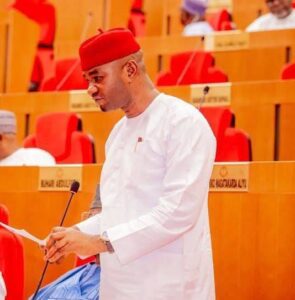
 When Silence Ceases to Be Golden: Why Senator Nwebonyi’s Outburst Over Alleged Anti-Party Activities Deserves Attention
By Romanus Uzor
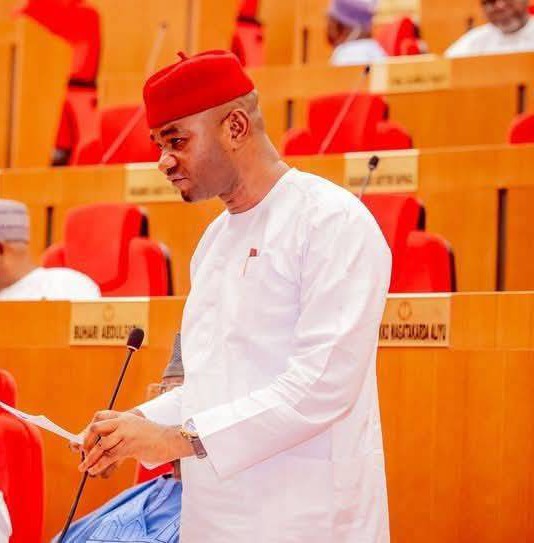
“He who remains silent in the face of perceived wrongdoing risks becoming an accomplice to it.” That timeless maxim aptly captures the circumstances surrounding Senator Peter Onyekachi Nwebonyi’s reaction during the recent Ebonyi APC stakeholders’ rally in Abuja. Whether one agrees with the manner of his intervention or not, the issues he raised deserve sober reflection rather than emotional condemnation.
At the rally, organised by members of the All Progressives Congress (APC) resident in the Federal Capital Territory under the leadership of Engr Henry Awuregu, a Commissioner in the Revenue Mobilization, Allocation and Fiscal Commission, the primary objective was to endorse Governor Francis Ogbonna Nwifuru for a second term in office.
According to reports, Senator Nwebonyi raised an alarm after noticing an individual allegedly clad in an APGA-branded shirt at the event. While some observers initially dismissed his reaction as unnecessary or exaggerated, subsequent accounts suggested that his concern may not have been without merit.
It is important to place the incident within its proper context.
The gathering was neither a cultural assembly nor a non-partisan meeting of Ebonyi indigenes residing in Abuja. It was an APC political rally convened specifically by party faithful to reaffirm their commitment to Governor Nwifuru’s administration and mobilise support ahead of the 2027 electoral cycle. Significantly, the rally commenced from the APC National Secretariat in Abuja, further underscoring its unmistakable identity as an official party event.
Against that backdrop, Senator Nwebonyi’s concerns become easier to appreciate. Political rallies are designed to project unity, reinforce party identity and inspire confidence among supporters. Consequently, the open display of another political party’s insignia at such an event naturally raises questions about loyalty, discipline and commitment to the party’s collective aspirations.
Ironically, many of those criticising Senator Nwebonyi today are often the same individuals who celebrate his courage, candour and unwavering disposition on the floor of the Senate and in the broader national political space. His reputation has largely been built on his readiness to confront issues head-on, regardless of whose interests may be affected.
Those who know the Senator understand that he has consistently demonstrated an uncompromising stance against actions he considers unjust or injurious to the ideals he represents. Remaining silent in circumstances where he perceives the integrity of his political party to be under threat would have been inconsistent with the character he has cultivated over the years.
More importantly, the Abuja incident presents an opportunity for introspection within the Ebonyi APC.
Political parties derive their strength not merely from numerical superiority but from cohesion, discipline and ideological consistency. Allegations of anti-party activities—whether eventually substantiated or disproved—should never be dismissed casually. Rather, they should be subjected to thorough internal scrutiny in the interest of preserving party unity and public confidence.
As preparations gradually intensify for the 2027 general elections, every responsible political organisation must remain vigilant against actions capable of undermining its internal cohesion. Loyalty is not merely a moral expectation within party politics; it is one of the foundational pillars upon which electoral success is built.
Nigeria’s constitutional democracy further reinforces this principle.
Under the nation’s electoral jurisprudence, political parties remain the primary vehicles through which candidates seek and obtain elective offices. This legal reality was firmly underscored by the landmark Supreme Court judgment in the celebrated case involving Rotimi Amaechi and Celestine Omehia. In that historic decision, the apex court held, in the peculiar circumstances of the case, that the electoral mandate belonged to the political party and that Amaechi was the rightful beneficiary of the votes cast on the PDP platform.
The implication is unmistakable: party identity, loyalty and discipline occupy a central position in Nigeria’s democratic architecture.
Consequently, allegations of anti-party activities transcend the personal interests of any individual politician. They go to the heart of institutional integrity, organisational stability and the long-term electoral viability of the party itself.
Supporters of Senator Nwebonyi maintain that his robust legislative performance, grassroots accessibility and unwavering commitment to the development of Ebonyi North Senatorial District have earned him considerable goodwill among his constituents, notwithstanding criticisms that periodically surface across social media platforms.
Furthermore, Nigeria’s electoral environment presents additional practical realities. In many rural communities, political party symbols often serve as the primary basis upon which voters identify candidates. Under such circumstances, conflicting political messaging or visible association with rival parties at official party events could create avoidable confusion among the electorate and potentially weaken campaign efforts.
For this reason, party discipline cannot be treated as a mere procedural obligation. It remains an indispensable ingredient for effective political mobilisation and electoral success.
Ultimately, if the All Progressives Congress is determined to consolidate its growing political influence in Ebonyi State ahead of the 2027 general elections, every allegation of anti-party activity should be addressed promptly, objectively and through the party’s constitutionally established internal dispute-resolution mechanisms.
The objective should not be persecution, but preservation of unity, discipline and collective purpose.
As the timeless adage reminds us, a stitch in time saves nine.
The time to confront allegations of anti-party activities through legitimate party processes is now—not after avoidable divisions have taken root.
Romanus Uzor Ozioko
Special Assistant to the Deputy Chief Whip of the Senate (Media and Publicity) writes from Abakaliki, Ebonyi state.

EDITOR
Sam Udekwe is a journalist working in the News and Current Affairs department, Enugu State Broadcasting Service (ESBS) Enugu. He is well trained in all genres of journalistic venture.
Mr Sam read Mass Communication, graduating all with Distinction in National Diploma, Higher National Diploma and Postgraduate Diploma at IMT, Enugu and Madonna University, Okija, Anambra state, as well as M.Sc Mass Communication at National Open University of Nigeria.
He is the immediate past NUJ Chairman, Enugu state.
samowailo@gmail.com