
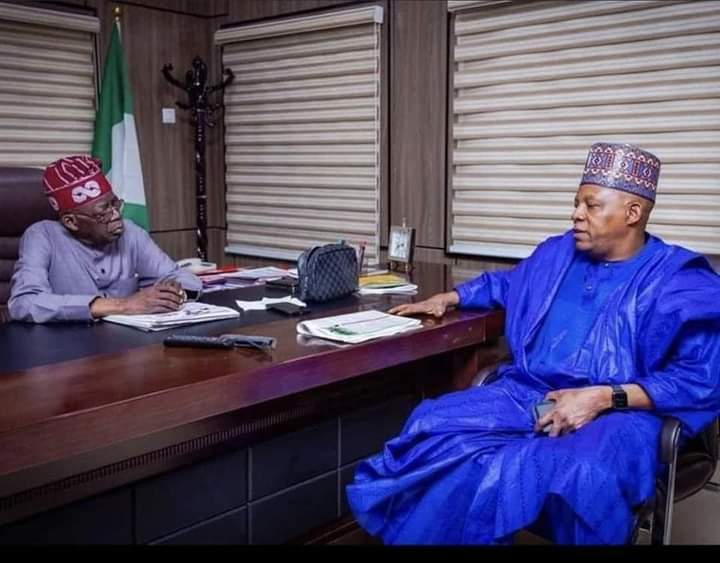
 Missing Image, Loud Message: Shettima’s Absence From APC Banner Sparks 2027 Intrigues
What began as a seemingly minor omission at a party event in Maiduguri has escalated into a revealing moment in the internal politics of the All Progressives Congress (APC), reigniting speculation about the future of Vice President Kashim Shettima ahead of the 2027 general election.
The incident occurred at the North-East Zonal Public Hearing on constitutional amendments, where a large banner behind the podium displayed the images of President Bola Ahmed Tinubu, governors from the zone and other senior APC figures. Conspicuously absent was the image of Vice President Shettima — a son of Borno State, former governor of the state and the highest-ranking APC official from the North-East.
The omission did not go unnoticed.
Abdulkarim Lawan, Speaker of the Borno State House of Assembly and Nigeria’s longest-serving speaker, drew attention to it when he mounted the podium. Instead of addressing constitutional matters, Lawan publicly questioned the absence of the Vice President’s photograph.
“Why would the Vice President’s picture not be included in the banner?” he asked.
The hall erupted in applause.
What could have been dismissed as a design oversight was quickly imbued with political meaning. For many party faithful, it appeared as a deliberate snub — and a provocation — particularly given its timing and location. Maiduguri is Shettima’s political home base, and the North-East remains one of the APC’s strongest support blocs.
Notably, this was not an isolated incident. A similar omission at an APC event in Gombe State last year reportedly led to a disruption that forced organisers to suspend proceedings. The Maiduguri episode, however, carried far greater symbolic weight.
It comes amid growing speculation within the ruling party that President Tinubu may consider replacing Shettima as his running mate in 2027, as debates intensify around the continuation of the Muslim–Muslim ticket and calls for religious balancing gain renewed momentum.
Within APC circles, the absence of Shettima’s image has been interpreted by some as giving physical expression to what had previously circulated only as rumours.
Reacting to the development, Abayomi Nurain Mumuni, an APC chieftain and security expert who served on the intelligence and security team of the Tinubu/Shettima Presidential Campaign Council in 2023, warned against any attempt to alter the ticket on religious grounds.
Mumuni argued that the North currently lacks a Christian political figure with the structure, grassroots acceptance and national reach capable of compensating for Shettima’s electoral value. He described loyalty and consistency — traits he attributed to the Vice President — as stabilising forces in governance.
While acknowledging calls for inclusivity, Mumuni cautioned that changing a winning formula could fracture party unity, disrupt governance and weaken the APC’s chances in 2027.
In the North-East, the idea of dropping Shettima is widely viewed not as political strategy but as betrayal.
That sentiment was echoed by the APC Youth Parliament. Speaking in Bauchi, its president, Kabiru Garba Kobi, dismissed rumours of Shettima’s replacement as divisive and dangerous. He warned that such a move could cost President Tinubu significant support in the region.
Kobi described Shettima as the most unifying political figure in the North-East and a crucial bridge between the region and the presidency. He cautioned against the influence of what he termed political opportunists who neither contributed meaningfully to the APC’s 2023 victory nor demonstrated loyalty to the party.
Behind the scenes, sources familiar with deliberations at the State House acknowledge growing concern about foreign scrutiny, particularly from the United States, over Nigeria’s religious balance. Statements by U.S. President Donald Trump on alleged Christian persecution in Nigeria have further sharpened debates within the ruling party.
While some APC leaders insist that Nigeria’s security and governance architecture already reflects religious diversity, others reject outright the notion that electoral decisions should be shaped by external expectations.
The resulting tension has blurred the boundary between domestic political calculations and foreign pressure.
Amid speculation that the North-Central zone is positioning itself to produce a Christian vice-presidential candidate, the North-Central APC Forum issued a public denial. The forum stated that it has no interest in the vice-presidential slot and is instead focused on contesting the presidency in 2031.
It warned that removing Shettima would amount to a grave political miscalculation, capable of shrinking Tinubu’s vote base and handing the opposition a strategic advantage in 2027.
Journalist and former presidential spokesperson, Reuben Abati, described the unfolding narrative as “a potentially disruptive speculation” that could damage both the APC’s electoral prospects and the working relationship between President Tinubu and his deputy.
Others have been less restrained. Political advocate Prof. Olusore Afuye argued that the Muslim–Muslim ticket is unlikely to survive beyond the current term, insisting that Tinubu would need a Christian running mate, most plausibly from the North-Central. Political commentator Engr. Arinze Cajet went further, alleging that a decision to drop Shettima had already been taken, citing unresolved internal issues rather than religion.
For now, Vice President Shettima has remained silent — on the missing banner, the rumours and the growing debate about his political future.
In Nigerian politics, silence is rarely accidental. It may signal restraint, calculation or preparation.
What began as a missing photograph in Maiduguri has evolved into a broader test of loyalty, power and political memory within the APC. As 2027 approaches, the ruling party faces a delicate choice: whether altering a familiar equation will secure its future or unravel it.
EDITOR
Sam Udekwe is a journalist working in the News and Current Affairs department, Enugu State Broadcasting Service (ESBS) Enugu. He is well trained in all genres of journalistic venture.
Mr Sam read Mass Communication, graduating all with Distinction in National Diploma, Higher National Diploma and Postgraduate Diploma at IMT, Enugu and Madonna University, Okija, Anambra state, as well as M.Sc Mass Communication at National Open University of Nigeria.
He is the immediate past NUJ Chairman, Enugu state.
samowailo@gmail.com